eczema
ˈɛksɪmə,ˈɛkzɪmə/
noun
a medical condition in which patches of skin become rough and inflamed with blisters which cause itching and bleeding.
Eczema
There is no cure for eczema, but, in most cases, it is manageable. The word
eczema comes from a Greek word that means to effervesce or bubble or boil over.
This website will help you answer the question “What Is Eczema?” and help you
understand it. It’s important to remember that many people have eczema. Over 30
million American may have it. There is no need to be embarrassed by your eczema.
You are not alone. Atopic Dermatitis (which
is often called eczema) is an itchy, red rash. It can appear all over the body.
Many people have it on their elbows or behind their knees. Babies often have
eczema on the face, especially the cheeks and chin. They can also have it on the
scalp, trunk (chest and back), and outer arms and legs. Children and adults tend to have eczema on the
neck, wrists, and ankles, and in areas that bend, like the inner elbow and knee.
People with eczema are usually diagnosed with it when they are babies or young
children. Eczema symptoms often become less severe as children grow into adults.
For some people, eczema continues into adulthood. Less often, it can start in
adulthood. The rash of eczema is different for each person. It may even look
different or affect different parts of your body from time to time. It can be
mild, moderate, or severe. Generally, people with eczema suffer from dry,
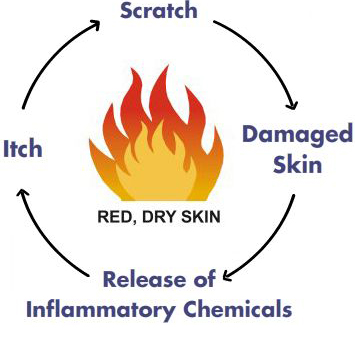
sensitive skin. Eczema is also known for its intense itch. The itch may be so
bad that you scratch your skin until it bleeds, which can make your rash even
worse, leading to even more inflammation and itching. This is called the
itch-scratch cycle.
Common
- Atopic dermatitis is an allergic disease believed to have a hereditary component, and often runs in families whose members also have asthma. Itchy rash is particularly noticeable on head and scalp, neck, inside of elbows, behind knees, and buttocks. It is very common in developed countries, and rising. Irritant contact dermatitis is sometimes misdiagnosed as atopic dermatitis.
- Contact dermatitis is of two types: allergic (resulting from a delayed reaction to an allergen, such as poison ivy, nickel, or Balsam of Peru), and irritant (resulting from direct reaction to a detergent, such as sodium lauryl sulfate, for example).
- Some substances act both as allergen and irritant (wet cement, for example). Other substances cause a problem after sunlight exposure, bringing on phototoxic dermatitis. About three quarters of cases of contact eczema are of the irritant type, which is the most common occupational skin disease. Contact eczema is curable, provided the offending substance can be avoided and its traces removed from one's environment. (ICD-10 L23; L24; L56.1; L56.0)
- Xerotic eczema (aka asteatotic e., e. craquele or craquelatum, winter itch, pruritus hiemalis) is dry skin that becomes so serious it turns into eczema. It worsens in dry winter weather, and limbs and trunk are most often affected. The itchy, tender skin resembles a dry, cracked, river bed. This disorder is very common among the older population. Ichthyosis is a related disorder. (ICD-10 L30.8A; L85.0)
- Seborrhoeic dermatitis or Seborrheic dermatitis ("cradle cap" in infants) is a condition sometimes classified as a form of eczema that is closely related to dandruff. It causes dry or greasy peeling of the scalp, eyebrows, and face, and sometimes trunk. The condition is harmless except in severe cases of cradle cap. In newborns it causes a thick, yellow, crusty scalp rash called cradle cap, which seems related to lack of biotin and is often curable.
Recommended for Eczema:
(click the picture to get more information)

Dermatitis symptoms vary with all different forms of the condition. They range from skin rashes to bumpy rashes or including blisters. Although every type of dermatitis has different symptoms, there are certain signs that are common for all of them, including redness of the skin, swelling, itching and skin lesions with sometimes oozing and scarring. Also, the area of the skin on which the symptoms appear tends to be different with every type of dermatitis, whether on the neck, wrist, forearm, thigh or ankle. Although the location may vary, the primary symptom of this condition is itchy skin. More rarely, it may appear on the genital area, such as the vulva or scrotum. Symptoms of this type of dermatitis may be very intense and may come and go. Irritant contact dermatitis is usually more painful than itchy.
Although the symptoms of atopic dermatitis vary from person to person, the most common symptoms are dry, itchy, red skin. Typical affected skin areas include the folds of the arms, the back of the knees, wrists, face and hands.
Dermatitis herpetiformis symptoms include itching, stinging and a burning sensation. Papules and vesicles are commonly present. The small red bumps experienced in this type of dermatitis are usually about 1 cm in size, red in color and may be found symmetrically grouped or distributed on the upper or lower back, buttocks, elbows, knees, neck, shoulders, and scalp. Less frequently, the rash may appear inside the mouth or near the hairline.
The symptoms of seborrheic dermatitis on the other hand, tend to appear gradually, from dry or greasy scaling of the scalp (dandruff) to hair loss. In severe cases, pimples may appear along the hairline, behind the ears, on the eyebrows, on the bridge of the nose, around the nose, on the chest, and on the upper back.[19] In newborns, the condition causes a thick and yellowish scalp rash, often accompanied by a diaper rash.
Perioral dermatitis refers to a red bumpy rash around the mouth.

Immunosuppressants
The United States Food and Drug Administration has issued a health advisory a possible risk of lymph node or skin cancer from these products, however subsequent research has not supported these concerns. A major debate, in the UK, has been about the cost of these medications and, given only finite NHS resources, when they are most appropriate to use.
When eczema is severe and does not respond to other forms of treatment, systemic immunosuppressants are sometimes used. Immunosuppressants can cause significant side effects and some require regular blood tests. The most commonly used are ciclosporin, azathioprine, and methotrexate.
Light therapy
Light therapy using ultraviolet light has tentative support but the quality of the evidence is not very good. A number of different types of light may be used including UVA and UVB; in some forms of treatment, light sensitive chemicals such as psoralen are also used. Overexposure to ultraviolet light carries its own risks, particularly that of skin cancer.Alternative medicine
There is currently no scientific evidence for the claim that sulfur treatment relieves eczema. It is unclear whether Chinese herbs help or harm. Dietary supplements are commonly used by people with eczema. Neither evening primrose oil nor borage seed oil taken orally have been shown to be effective. Both are associated with gastrointestinal upset. Probiotics do not appear to be effective. There is insufficient evidence to support the use of zinc, selenium, vitamin D, vitamin E, pyridoxine (vitamin B6), sea buckthorn oil, hempseed oil, sunflower oil, or fish oil as dietary supplements.Other remedies lacking evidential support include chiropractic spinal manipulation and acupuncture. There is little evidence supporting the use of psychological treatments. While dilute bleach baths have been used for infected dermatitis there is little evidence for this practice.
Recommended for Eczema:
(click the picture to get more information)
#eliminateeczema #cureeczema #eczemabuster #swag #instacure #girls #instacool
#cool #bestoftheday #instalike #tagforlikes #instagood #jobs #purpose #win #betteryou

No comments:
Post a Comment